
It’s the 4th of July, and I’m feeling American and proud. Last week, the Supreme Court ruled that same-sex couples have a right to marry anywhere in the United States. What a victory for America, said Barack Obama, praising those who had fought long and hard for the right over four decades. “Sometimes,” he said, “there are days like this, when that slow steady effort is rewarded with justice that arrives like a thunderbolt.”
I have been lucky to live in Iowa, one of the first places to declare marriage equality, and then later here in Florida on Jan. 6, when the movement toward marriage equality had become a growing unstoppable tide. In Iowa, justice did come like a thunderbolt. It was in April 2009. Loud heated debate and legal and political battles over marriage equality were happening on the East and West coasts, when the Iowa Supreme Court with typical Midwestern understatedness issued a ruling that state law limiting marriage to a man and a woman was unconstitutional. Who expected it from Iowa? Iowa, the land of potatoes or cornfields (no one ever gets it right between Iowa and Idaho), hard working salt of the earth types, as captured by Iowan Grant Wood in his classic painting “The American Gothic” (Grant Wood incidentally was gay).
I was an education director at the Unitarian Universalist Society of Iowa City at the time, and the decision brought a flood of couples from all over the country to our church (not only was Iowa one of the few states that would allow same-sex marriage, but our church belonged to one of the few religious organizations that sanctioned same-sex marriage). Our particular claim to fame came when a couple from St. Louis used social media to invite couples to participate in a mass wedding in Iowa. The response was so positive, they got in touch with us, rented a bus, loaded it up with 25 couples, several rabbis, and a UU stand-in minister for the faith-of-your-choice. It was our first multi-wedding event. We would have many more, and become known as the Love Bus church.
Our other claim to fame was a young man named Zach Wahls with two moms. Zach’s family had been active in the church for many years. And I saw him grow into the kind of person with esteem and values I’d like to think were partly shaped by our religious education program. Zach — suited and clean-cut, a sixth generation Iowan, 99 percentile on his college aptitude tests, Eagle Scout, debate champion, and 19 year-old Engineering student at the University of Iowa — gave an impassioned speech to the Iowa legislature on Feb. 2011 urging them not to pass a constitutional amendment that would ban gay marriage and civil unions.
“My family really isn’t so different from yours. After all, your family doesn’t derive its sense of worth from being told by the state, ‘You’re married, congratulations!’” There was no ban issued. Zach’s speech went viral, and Zach would go on to write the book My Two Moms, be a guest on late night shows, a speaker at the Democratic Convention, and finally to the relief of those of us who truly cared about his future, a university student, graduating just a little later than his peers.
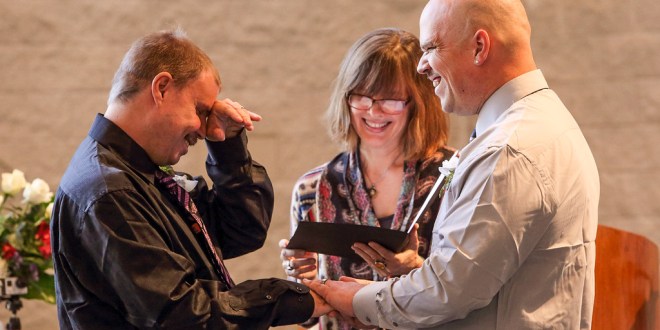
When I came to Florida last year to serve as a ministerial student intern at First Unitarian Church of Orlando, I was a witness to more history making. Here was a church in the land of Disney World, which knew innovation and product. At the Pride Parade, we handed out bold blue paper fans in the blistering heat of the October day to the throngs gathered. The fans said “We Want to Marry You.” We promised free weddings when the “stay” on equal marriage had been lifted. That happened on Jan 6, 2015. And on June 10, I found myself one of three officiants for an all-day wedding event. Rev. Kathy Schmitz of First Unitarian, former minister Marni Harmony and I took turns marrying 15 couples. In the glassed in Wiggle Room at the back of the sanctuary, for parents and squirming babies, I received and waited with each couple before our turn for their ceremony. There, I heard a little of their story, enough to know they had been together for years, their devotion was true, and they were ready for the civil rights they deserved: health insurance, property, tax benefits, recognition as a family. It was time to celebrate. Some wore sneakers, top hats and tuxedos. Some danced down the aisle. Most shed tears.
Barrack Obama is right about the slow steady effort. From what I know of my Unitarian Universalist tradition, we have tended to LGBT rights since 1973 — filing court cases, joining amicus curiae briefs, writing petitioning, visiting, and calling legislators, made 1-on-1 visits with friends, family members, and strangers, staffing phone banks, holding press conferences, conducting worship services, and everything else needed to make marriage equality a reality throughout the United States. “The arc of the moral universe is long,” said Martin Luther King Jr., “but it bends toward justice.” It sure feels that way today. It’s time to set off the fire works.
 A Creed of Curiosity