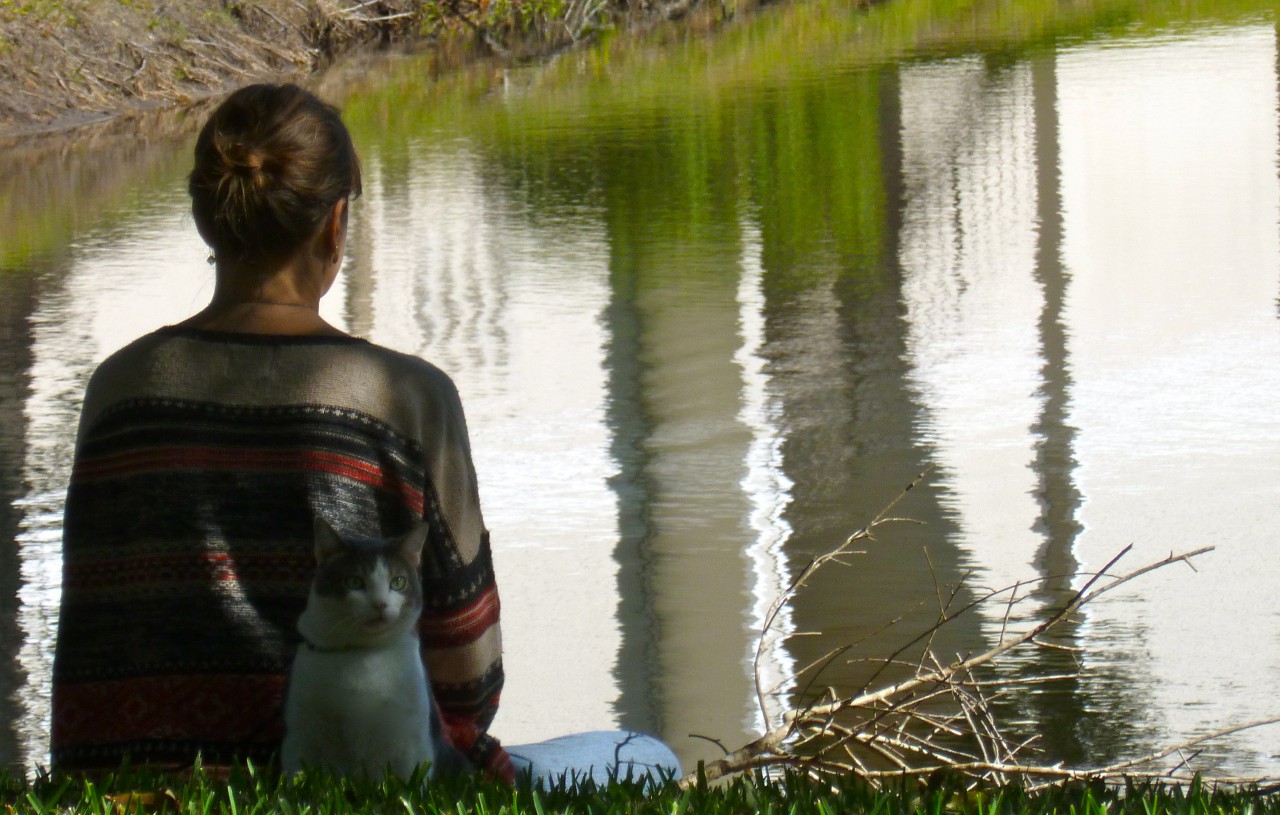
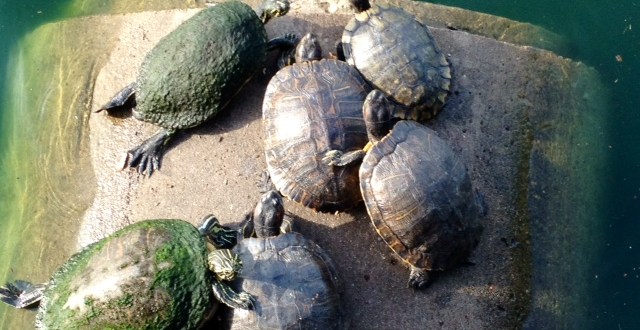
Here in Orlando there are a lot of water bodies and sinkholes, happy homes for waterbirds and turtles. At some of the larger lakes, water turtles cluster and circle thickly like coy when people offer them bread. Sometimes, they sun in groups of five or six on the buttress of a park bridge. They are harder to spot in the pond of the apartment community where I live. The water is thick with scum and moss, and I can barely make out more than just a small, dark reptilian head coming up for air and skittishly submerging again. A spotting often feels auspicious to me, like the turtle has come to teach me of some important lesson.
My relationship with turtles began with one of those family vacations driving across at least four states in the blue Chevy, when we rescued three box turtles found baking on their backs the side of the highway. Our parents let us take them home, as a compensation for the pet deprivation while my father was in graduate studies. Timothy, Green Head and Jackie were sturdier than the short-lived dime-store turtles that preceded them as pets. They ate an enormous amount, their jaws opening wide on square hinges, the velvety pink tongues rolling milky bread twirled into worm-like entreaties, or on good days, the real thing dug from the back yard, down their deep gullets. I liked to watch the expanding of the brilliant yellow striped patterns on Timothy’s neck as he craned to eat.
In absence of a dog, we walked the turtles, sometimes lining them up along a crack in the sidewalk and laying bets on whose would win. They seldom cooperated, and we watched with impatience, as they instinctively turned away and trundled off the pavement and into the dirt and grass. We never gave up on their purpose to please us as our pets, and I remember many days running home from school and pulling the cardboard box out from under my bed, tapping and jiggling Jackie to wake, and then watching the slits of her eyes expand to sleepy films, which rolled away into black knowing orbs. But in the winter, they could not be coaxed. They dug deep into the dirt of their cardboard box, and lifted the drawbridge of their shelled home, not emerging until the spring. We honored this sojourn into the deep, keeping the boxes tucked under our beds with few interruptions, but we welcomed them with shouts and hoots when their bodies slowly throbbed back to life in the spring.
Years later, in a personal development seminar, my connection with turtles took on another layer. In an exercise to help us access unhealthy patterns in our behavior, the seminar leaders likened me to a turtle. Others were likened to other things: the messy teenager, the Barbie doll, the runner always on the starting line. The point of the exercise was to act out these roles in a darkened conference room with the facilitators staring sternly on, until our dramatizations began to sink in and have a sobering effect. My friend, the “runner stuck with her foot in the starting block,” sat on my back, and so for a while, we plodded along, giggling and smirking, refusing to take the exercise seriously. Soon, the facilitators separated us, and I found myself trundling over the carpeted floor on my own, confronting my lack of participation in the course, how I would poke my head out and say something once in a while, but not a steady contribution. Finding my voice was something I struggled with my whole life – as a child, I had difficulty making myself heard in a family of mostly extroverts and one very domineering parent — and emerging and retreating had become my pattern, as deeply etched as the ribbings on a turtle’s underbelly.
But was this so bad? Once on a service trip to the highland communities in Guatemala, a group of us met a Guatemalan artist who offered to look up our Mayan zodiac signs. Mine was an auspicious sign, a turtle, he said. According to mythology, the turtle was the first in creation and the world was built on its back. It was a good leader, not only because of experience and wisdom and all that comes from being old, but because it could retreat into the darkened corners in its shell and undisturbed, create its vision for the world. Yes, a good sign indeed, said the artist. I liked what I heard. My Mayan zodiac sign was offering me a gift with my introversion – I could create something in my cycle of retreat and emergence.
In native traditions, human beings are accompanied throughout their lives by animal spirits. The power animal is one’s personal totem, a creature whose ways inspire you, give you strength, a symbol that can turn up in visions and dreams, and in the flesh, in scale and shell. Mine, I’m sure is a turtle. But someone more insightful than me said I should consider a sea turtle. This was a thought. I like large bodies of water. And until many years in Iowa, I had lived in coastal cities, New York, Chicago, Hong Kong, and Taiwan, where I was raised. The sea could represent fathoms and depths of unchartered territory, freedom and flow, fluidity and mystery – quite an auspicious habitat for dwelling. Other qualities sea turtles bring to mind: they are endangered; there are not too many of them around; the eggs they do lay are the offerings of journey and hardship, and are true treasures. There are some habitats that are easier than others for the sea turtle. The hatched young know this, making their way on spongy flappers to the welcoming foam of the sea without a mother’s guidance. The sea turtle knows not to stay away from its habitat too long – it goes where it is nourished, diving deep. And yet it can go far, because it carries its home with it, a strong sturdy home that holds nothing fearsome, but respite and restoration. What a great creature to have as a power animal. I could definitely learn from sea turtle.
If I should close my eyes to the significance of the turtle, I am sure it will send me a reminder. Like some lucky days here in Florida, when I step out of my porch and survey the pond, and spot there on a boulder a water turtle sunning. It raises its bold and beautiful striped neck.
“Ah, my friend, you again,” I murmur.
 A Creed of Curiosity